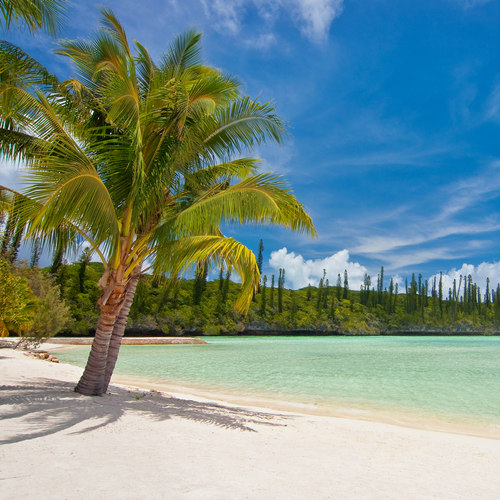
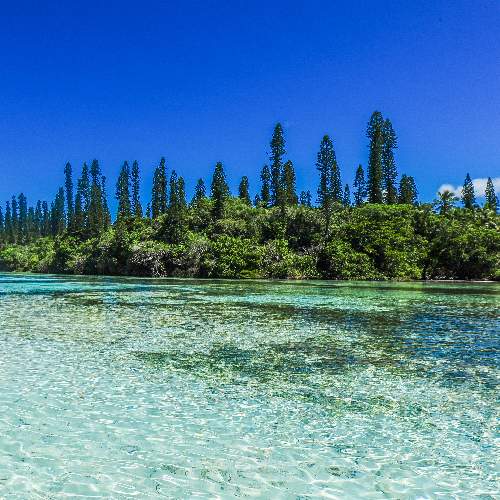
Visit the heart of the Pacific, as the region of New Caledonia is often called! One of the most remote overseas territories of France will welcome you with a climate of eternal spring, with over 300 days of sunshine a year, untouched nature with countless coral reefs and a green interior, and a melting pot of ethnic communities with extremely diverse origins and cultural heritage. Discover the spectacular landscapes of Ile des Pins and the Lifou coral reef, the local specialities and culture of Noumea and one of the most beautiful islands in the archipelago, Ouvea. A holiday in New Caledonia is a pleasure for all the senses!
Programmes
Hotels
Weather
Places
Information
Inspirations
General Information
Time zone
GMT+11
Chair
Noumea
Language
French, regional languages including Kannaki
Currency
CFP franc (1 franc is 100 centimes). Banknotes have denominations: 500, 1000, 5000, 10 francs. Coins have denominations: 000, 1, 2, 5, 10, 20, 50 francs.
Polish citizens traveling to New Caledonia are not required to have visas, unless the trip is related to taking up gainful employment, but it is mandatory to have a valid passport (for 3 months after the date of return to the country).
Vaccinations
There are no mandatory vaccinations before travelling to New Caledonia, however it is worth considering getting vaccinated against tetanus, diphtheria and polio (approx. PLN 150) and foodborne hepatitis (approx. PLN 250 for each dose of the vaccine). Vaccination prices are given in accordance with the current price list of the Vaccination Centre of the John Paul II Specialist Hospital in Kraków.
There is no malaria risk, but it is recommended to use appropriate repellents and protection against bites. There is also a small chance of poisoning with marine toxins when eating some types of fish. It is suggested to eat fish in trusted places (restaurants).
Tips
There is no widespread custom of leaving tips locally. It can be encountered sporadically, as well as rounding prices. Of course, such a form of additional gratification is always welcomed by the staff or drivers.
Food prices
Prices are generally not among the highest in the region, comparing them to the French ones we can assume that they will be higher by 20-30%. Of course, top resorts and luxury hotels are an exception to this rule, but compared to Fiji or French Polynesia they are significantly lower.
Sample prices:
Meal at a cheap restaurant – 2400 CFP Three-course meal at a mid-range restaurant – 4200 CFP Local beer 0,5 l – 130 CFP Imported beer 0,3 l - 670 CFP Mid-range wine – 1500 CFP Cappuccino in a cafe – 480 CFP Coca-Cola 0,3 l – 330 CFP Water 1,5 l - 110 CFP Bananas 1kg – 600 CFP Oranges 1kg – 730 CFP
Food
Local cuisine is a real feast for the senses! The exotic location and tropical climate of the islands provide access to excellent fruits and a large selection of vegetables. The omnipresent water means countless fishing opportunities and a wealth of choice. The culinary culture of the colonizer also had a great influence on the island traditions - French and local flavors coexist and interpenetrate.
A stay there is an opportunity to try the tastiest fish – this is the basis of the local cuisine available in every form (be sure to look for maki-maki), crabs, oysters, mussels and shrimp, often baked or grilled and stewed with curry and coconut. Another unusual delicacy is the local snails from the Isle of Pines or the popular game on the main island in the form of grilled skewers or a filling ragout. The culinary hallmark of the islands is bougna – a Kanak dish based on poultry, lobster, fish with the addition of sweet potatoes, bananas or taro. The whole thing is wrapped in banana leaves and baked in special earth ovens, on hot stones. Fresh fruit and nuts are often an addition to dishes or snacks, and the French influence is most visible in a glass of wine with dinner, finished with a cup of aromatic coffee.
Interesting facts
There are large deposits of nickel and cobalt here. Their extraction is a huge part of the economy and accounts for over 10% of the world market – a lot, considering the modest size of the island.
In recent years, independence from France was considered, but in a referendum the majority of residents rejected the idea.
In terms of area, New Caledonia is closest to Wales, but its population is only 1/10 of that country's population, the vast majority of which live in the capital, Nouma.
New Caledonia is home to 22 endemic bird species and its shores are home to one of the largest coral reefs in the world.
French is widely spoken and spoken on the island by almost everyone, but there are also over 30 different dialects, mostly local ones.
If you like countries unspoiled by tourism, this is the place for you! The number of visitors in 2019 was estimated at just 100.
About 40% of the population are Kanaks, the indigenous inhabitants of these lands.
Although cases of cannibalism were reported here in the 19th century, today you are no longer in danger.
The temperature rarely drops below 20 degrees, and there is abundant rainfall throughout the year, but it is not too burdensome. The climate here is exceptionally pleasant, and the country is called the "land of eternal spring."
The most famous Caledonian is Christian Karembeu, former Real Madrid and French national team player, world champion in 1998.
Learn more about the country of New Caledonia
History
The history of the islands and settlements dates back to 1500 BC – it is to these years that the settlement of the islands dates back. Then, in the 1774th century, Polynesian people arrived on the island, who mixed with the original inhabitants over the next generations. The modern history of the region does not begin until XNUMX, when Captain James Cook discovered the islands during his second voyage around the world. The shapes of the islands reminded sailors of the coast of Scotland – hence the reference to the name of the historical land of Caledonia, located in the north of Great Britain, the only part of this island that was not conquered by Rome.
The history of New Caledonia has been linked to France since 1853. First, there was a penal colony for participants of the Paris Commune, and in subsequent years, repressive decrees were used to restrict the freedom of the indigenous inhabitants, who were the workforce for the new rulers. Numerous uprisings in which the Kanaks tried to free themselves from the colonialists' rule did not bring about a change in the situation. During World War II, there was a strategic base of Allied forces in the Pacific. Only after the war, as in the rest of the world, did the processes of decolonization accelerate, as did the restoration of freedoms to citizens and the establishment of equality before the law - in the case of New Caledonia, the symbolic date is 1957, when the Kanaks obtained full voting rights.
Independence processes and referendums on independence have been ongoing since the 70s. Since 1998, New Caledonia has been an overseas territory with a special status and is fully administratively independent. In 2018, the idea of separating from France was rejected by referendum. Further referenda have been announced for 2020 and 2022.
Location
New Caledonia is located about 1300 km from the east coast of Australia, just over 2 hours' flight from Sydney, Brisbane or Auckland. They consist of the Main Island with the capital Noumea and an archipelago of several smaller islands - the Loyalty Islands, Ile des Pins and Chesterfield Islands. The landscape is mostly quite mountainous, and the climate is mild and tropical. Along the coast there are coral reefs, some of the longest in the world, and the coastline itself is quite diverse: there is no shortage of rocky cliffs, bays and peninsulas jutting into the ocean waters. Water sports enthusiasts will not be disappointed, while beach lovers will also find postcard landscapes associated with Pacific islands and relaxation under palm trees.
The highest peaks on the island reach over 1600 meters and are of volcanic origin, together with the dense and evergreen vegetation, creating fantastic places for naturalists and active tourists. Many years of isolation have resulted in the islands being inhabited by many endemic species of fauna and flora: it is especially worth mentioning the birds and underwater life, which can be easily admired while diving - this is one of the best diving destinations in the world. Visitors are also favored by good or even great weather, which lasts most of the year: there are over 300 sunny days, temperatures rarely fall below a pleasant 17-20°C and just as rarely rise above 30°C.
Culture and Religion
The culture reflects the traditions of the original inhabitants of the island, in whose lives dance and music played important roles. Even modern music tries to combine current rock, reggae or soul sounds with Kanak music. Everyday influences of French and European customs and lifestyles are obvious, but for the indigenous people traditional forms of expressing respect, social bonds or feelings are still important. Welcome ceremonies and inviting someone to your home or village are particularly important and present. Woodcarving (totems, masks, jewellery) and basket weaving dominated the traditional arts.
As in France, Christianity is dominant here, and there is freedom of religion. The indigenous people and the Kanaks have their own traditional animalistic and primitive beliefs, but they are rarely cultivated. There are also religions such as Islam, whose followers are mainly descendants of Indonesians and Algerians from the colonial era, and Buddhism, introduced by social minorities from Asia.
New Caledonia lies in a mild equatorial climate zone shaped by monsoon winds. In the dry season – from April to November – the average air temperature is between 17 and 23°C, while in the rainy season – from December to March – the mercury usually indicates between 26 and 29°C, sometimes rising to 32 degrees. The warmest month is January, when you can expect an average of 27°C, and the coldest in July – the air temperature then drops to 22 degrees. In the mountains, the mercury column drops by an average of 4-5 degrees, and rain becomes more abundant. Annual rainfall is between 1000 and 2500 mm.
A trip to New Caledonia can be planned all year round, because both during the dry and rainy seasons the water temperature does not drop below 20°C, and there are only twenty days a year when the sun does not appear for a moment.