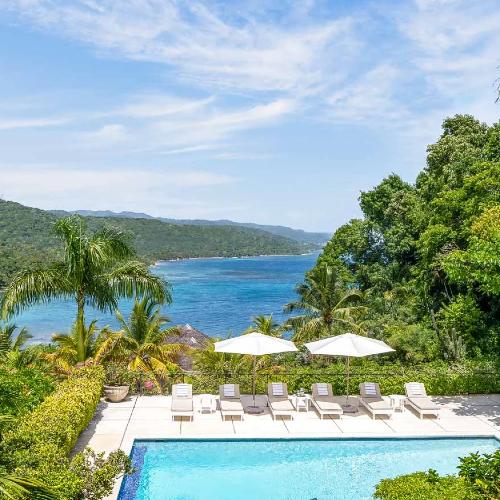
A holiday to the rhythm of reggae under a palm tree bending towards the sea? Jamaica promises a dream holiday, where music seeps between atmospheric pubs, people dance on the beach, and ripe mangoes and bananas hang from green trees. Paradise beaches with white sand, an interior covered in green jungle and a unique culture. During a trip to Jamaica you will be able to dive on a colorful reef, go trekking, taste local rum, listen to the bass vibrating in the air and relax on the warm sand by the crystal clear waters of the Caribbean Sea.
Hotels
Weather
Places
Information
Inspirations
General Information
Time zone
GMT-5
Chair
Kingston
Language
The official language of Jamaica is English, but some residents also speak Jamaican Creole, a language based on English. Jamaican is mainly used in speech, and other names include Patwa and Patois. The development of the Jamaican language was influenced not only by English, but also by African languages, including those from the Bantu family.
Currency
In Jamaica, the official currency is the Jamaican dollar with the international code JMD. 1 Jamaican dollar is divided into 100 cents.
Citizens of the Republic of Poland are not required to have a tourist visa when traveling to Jamaica. If the stay exceeds 30 days, a visa is required, which is issued by the Jamaican Embassy in Berlin. To obtain a visa, you must have a passport valid for 6 months from the moment of crossing the border of Jamaica, as well as one passport photo and a plane ticket. Sometimes customs officers ask individual passengers to show sufficient funds for their stay on the island (e.g. traveler's checks, cash). Travelers can obtain a tourist visa at the airport. Airport fees are usually included in the price of the plane ticket, e.g. on Lufthansa or Air Berlin.
The Travel Agency is not responsible for failure to obtain a visa for the country where the tourist event is held, or for transit countries. Obtaining a visa is 100% the responsibility of the participants of the trip.
Vaccinations
Before going on holiday to Jamaica, vaccinations against diphtheria and tetanus (approx. PLN 80), typhoid (approx. PLN 210) and hepatitis A and B (approx. PLN 240) are recommended. Travelers from South American and African countries where cases of yellow fever have been documented are required to have a document confirming vaccination against the above disease (approx. PLN 200). Vaccination prices are given in accordance with the current price list of the Vaccination Centre of the John Paul II Specialist Hospital in Krakow.
Tips
Tipping is a custom in Jamaica. In a restaurant, it is worth checking whether the tip has not been added to the bill in advance - if not, it is recommended to leave a tip of around 15-20% of the order value. In hotels, it is appropriate to reward a concierge for additional services, a porter or a maid who cleans the room with a tip. It is less common, but still accepted, to tip tour guides, e.g. those organized by the hotel, tour bus drivers and taxi drivers.
Food prices
The prices of food and other dishes in Jamaica are incomparable to the cost of food in parts of Asia, and the Caribbean and Latin America in general are quite expensive. Despite this, you can eat well and at a decent price in Jamaica. You can pay in US dollars almost everywhere. It is best to go to local, less touristy places where locals eat and shop. If there are no prices on the menu or on the menu posted in a given place, you should definitely agree on the cost of the meal in advance. Example prices: coffee or tea in a cafe about $1,5, Pepsi $2, lunch in a restaurant about $5, beer $2, mineral water 60 JMD, freshly squeezed fruit juice from 100 JMD, lunch in a local pub from 150 JMD, bottle of rum from $5.
Food
The national way of preparing meals in Jamaica has been... grilling! On the island, chicken, pork and fish are mainly grilled, and less often turkey. Before going on a paradise vacation, it is essential to familiarize yourself with the word "jerk" or "jerking", which is a description of the method of marinating meat, seafood or cheese in the Caribbean Islands and North America. Currently, jerk marinades can take on various forms. The traditional marinade mainly consists of allspice, salt, paprika, thyme, cinnamon or onion. Rum, popular on the island, is also used for marinades, especially in the case of pork. Rum is a drink that you absolutely must try during your trip to Jamaica. And if someone gets tired of rum, they can easily reach for a local beer, e.g. Red Stripe.
In Jamaica, people are very keen to reach for fruits and vegetables, and this is mainly influenced by the fact that one of the social groups in Jamaica - followers of the Rastafari Movement, practice a mostly vegetarian diet. The most characteristic and common fruit is ackee - a tasty fruit with yellow flesh, which is most often eaten for breakfast on the island. Surprisingly, ackee is often served with salted fish! Desserts on the island include primarily bread pudding, sometimes with the addition of caramel. The most popular fruit is ackee, whose Polish name sounds quite complicated compared to its English equivalent: bligia pospolita. The English term used in Jamaica comes from the African language Twi.
Despite the hot climate, Jamaican residents are keen on tea. The famous drink called Irish Moss is made from tea, to which rum, milk and various spices are added. The most commonly used ingredients in the kitchen include ackee, green bananas, coconut milk, cassava, breadfruit, pineapple, garlic, dried and salted cod, beans and avocado.
Interesting facts
The official ruler of Jamaica is the Queen of Great Britain, Elizabeth II.
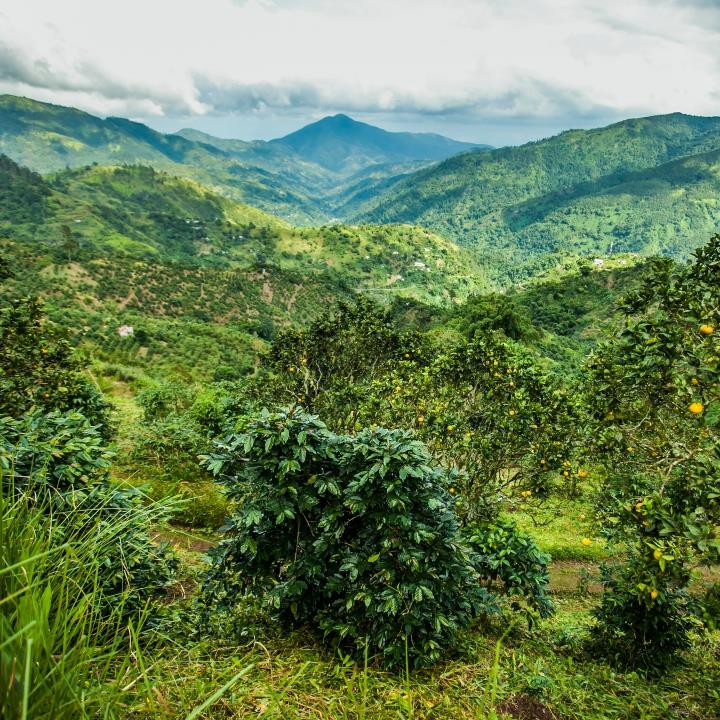
Jamaican coffee called Blue Mountain is considered one of the most expensive and best coffees in the world.
Ackee, almost the national fruit of Jamaica, takes its name from Captain William Bligh, who initiated the cultivation of ackee in Jamaica.
In Jamaica, traffic drives on the left.
The island was once visited by the greatest celebrities of the modern world, including Charlie Chaplin, Elizabeth Taylor and Queen Elizabeth II.
The author of the famous series of books about the adventures of James Bond, Ian Fleming wrote his novels in a residence in Jamaica.
Rastafarians considered the cruel Emperor of Ethiopia, Haile Selassie, as their spiritual leader. Interestingly, the Emperor's real name was Tafari, and the nickname Ras, meaning "prince," came to be used when he was governor of one of the Ethiopian provinces—hence the name of the religious movement, Rastafari.
The former capital of Jamaica was Sante Jago de la Vega, now called Spanish Town. It is the second largest city on the island and the place where you can visit the most historical monuments. It is home to one of the oldest Anglican churches outside of Great Britain. Popular Jamaican sprinter Asafa Powell comes from this city.
Learn more about Jamaica
History
Jamaica came into being for the New Continent in 1494, when it was discovered by Christopher Columbus, who began the period of Spanish dominion over the island. Before that, Jamaica was inhabited by Indians from ethnic groups known as Arawak, who were initially used by the Spanish to work on sugar cane plantations. The physically weaker native inhabitants of the island were replaced by African slaves brought from the Dark Continent.
In the 1655th century, people from other European countries began to emigrate to Jamaica, including the French, English, and Dutch. In 1833, the British occupied the island, but Spain officially relinquished it over a hundred years later. Great Britain developed rum production and founded an urban center called Kingston, the current capital of Jamaica. In XNUMX, slavery was abolished here, but not before a crisis in the sugar market led to the deaths of thousands of black plantation workers. Towards the end of the XNUMXth century, discontent over the poor living conditions of black residents grew on the island.
In 1945, one of the most famous Jamaicans, Bob Marley, was born. It was not until 1962 that Jamaica gained independence from Great Britain and the East Indies Federation. Since then, it has been a member of the British Commonwealth of Nations and is a constitutional monarchy headed by Queen Elizabeth II.
Location
Jamaica belongs to the Greater Antilles archipelago, located in the Caribbean Sea, near Cuba, Haiti and the Dominican Republic. Its area is almost 11 thousand km², length about 230 km², and at its widest point it is 82 km². More than half of the island's land rises to a height of 300 m above sea level, and the highest peak is Blue Mountain Peak, which is 2256 m above sea level. Large areas are also occupied by highlands exceeding 500 m above sea level. Interestingly, Jamaica has no seasons at all. The weather on the island satisfies even the most demanding tourists, because the average annual temperatures oscillate around 27 degrees near the sea, while in the higher parts they drop to around 20 degrees. Annual temperature amplitudes do not exceed 5 degrees Celsius! The coastline of Jamaica is filled with numerous bays, including: St. Anne, Hope or Boston, the coast is mostly mangrove, covered with mangrove forests, but the island also has paradise beaches of white sand covered with palm trees. Beautiful coral reefs occur around the southern coast. Forests make up about 25% of the total area, consisting of valuable mahogany, ebony and rosewood. Part of the forest areas are tropical forests.
The largest number of animals live in tropical forests. The most dangerous of them are crocodiles, which, however, do not occur in large numbers. In addition, in some areas you can encounter wild pigs, and various rodents and reptiles are quite common. The rare Jamaican rabbit, which resembles a guinea pig, seems to be particularly characteristic. Among reptiles, it is worth mentioning geckos, which are small lizards, as well as snakes, which are quite common. There are also quite a few bats living in Jamaica, which are particularly suited to the local living conditions. The Jamaican bird world is also rich, with about 200 species, of which the black-headed hummingbird is associated with Jamaica.
Culture and Religion
Native Jamaicans make up over 91% of the island's population, while the remaining minority includes Indians, Chinese, British, Arabs, and a very small group of other nationalities: Cubans, Americans, Portuguese, and Spaniards. Some Jamaicans call themselves Maroons, who are descendants of escaped black slaves and live in Latin America, mainly Jamaica, Brazil, and Suriname. The ancestors of this people were the first in both Americas to gain freedom.
Unlike other Latin American countries, Jamaica has seen the complete destruction of the culture of the island's first known inhabitants, namely the Taino Indians. The turbulent fate of Jamaican lands has significantly influenced the current shape of local customs and culture, which have absorbed the customs, beliefs and characteristics of the Spanish, English and former slaves from Africa. An extremely important element of cultural life has remained for years the Rastafari Movement, the beginnings of which can be traced to the fight for racial equality and the concept of returning to Africa, i.e. Back to Africa.
The cultural icon of Jamaica is Bob Marley, which is hard to miss, as his image is placed on buildings, T-shirts, posters and various souvenirs for sale. Marley, or rather Robert Nesta Marley, was a reggae musician and its world-famous popularizer. In addition, Marley considered himself a supporter of Pan-Africanism, a political movement that assumed solidarity of the African people and those of African descent, popularizing their culture and emphasizing their distinctiveness.
About 60% of all Jamaican citizens declare their religious affiliation to Christianity, or more precisely – Protestantism. As many as 20% of those taking part in the census consider themselves atheists. Pentecostals make up 20% of the population, the Seventh-day Adventist Church is almost 12%. Smaller beliefs include the Church of God's Prophecy, Baptists, the Church of God in Jamaica, Anglicanism, Methodism, Jehovah's Witnesses and the Moravian Brethren. One of the minorities also includes followers of the Rastafari Movement.
The climate of Jamaica is described as tropical, with temperatures almost the same throughout the year, ranging between 24 and 30°C. The southern coast, including the capital of the island - Kingston, is slightly warmer, with temperatures averaging around 2-3 degrees higher than in the rest of the country. The best time to visit Jamaica is during the dry season, which falls between November and May. The rest of the year is a hot and muggy rainy season, with precipitation - usually in the form of intense thunderstorms - occurring almost every afternoon. The southeast trade winds present in the Jamaica region also mean that the peak rainfall does not occur in the middle of the rainy season, but in May and October - the transitional months. The exception here is the western coast and the area around the town of Negril. The water temperature fluctuates around 27-28°C almost all year round, and visitors can expect at least 7 hours of sunshine per day. As with the rest of the Caribbean islands, Jamaica can be subject to hurricanes during the rainy season, with the greatest number occurring between August and October.
There is probably no one who would not associate Jamaica with Bob Marley and reggae music. During your trip to this laid-back island, you will find that it is an inseparable part of life...
Is there a hidden treasure in Jamaica? If you ask a Jamaican, they will probably direct you to Treasure Beach. It is an island treasure in its own right. A must-see when traveling in Jamaica!...
While traveling in Jamaica, take a trip to the Blue Mountains. A thicket of ferns, vines, mosses and lichens, shrouded in damp mist and covered in a cloak of twilight, stimulates the imagination. Feast your eyes on the exotic lush...