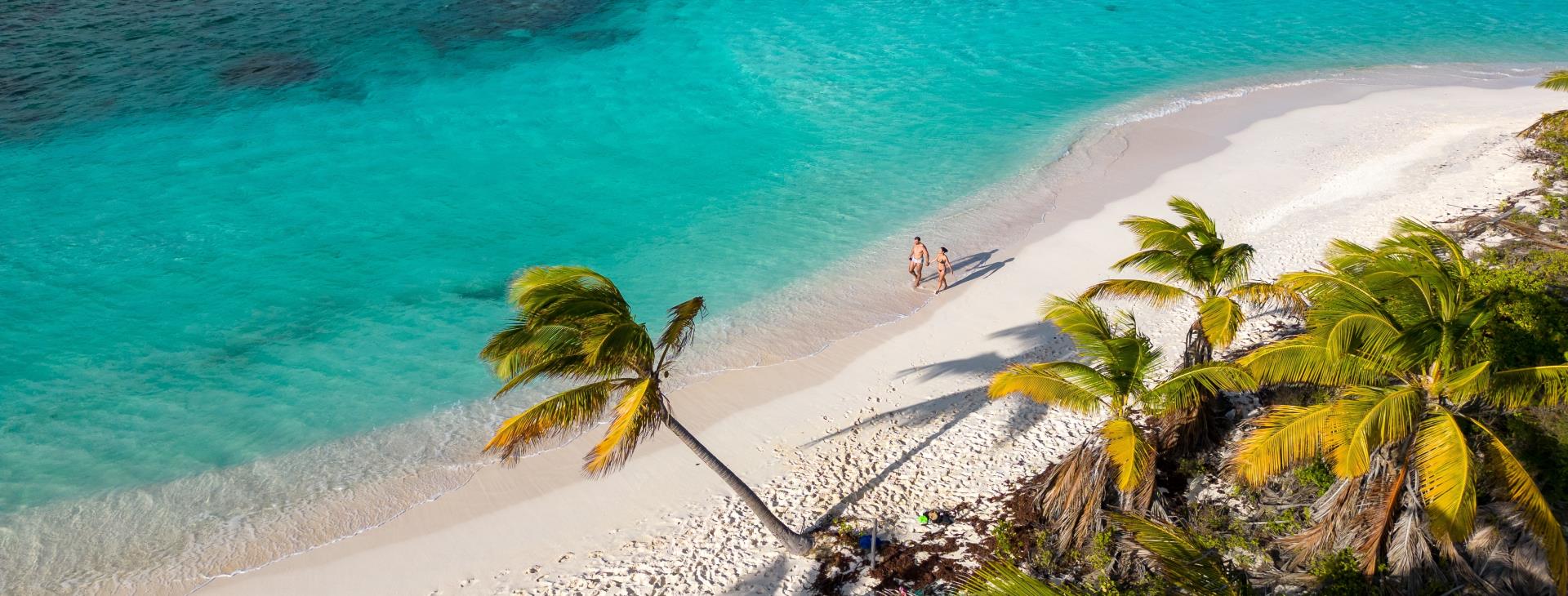
33 beautiful beaches, just 20 exclusive hotels and 70 restaurants serving Caribbean cuisine as well as the tastiest dishes from all continents, extremely nice people and some of the best snorkeling and kitesurfing spots in the Caribbean are just some of the reasons to visit this most luxurious holiday island in the world. Go to these untouched areas of the Antilles and spend a luxurious holiday in Anguilla enjoying undisturbed peace, wonderful nature and the warm glow of the Caribbean sun!
Programmes
Hotels
Weather
Places
Information
Inspirations
General Information
Time zone
GMT-4
Chair
The Valley
Language
English
Currency
East Caribbean dollar (1 XCD is 100 cents). Notes come in denominations of 5, 10, 20, 50 and 100 dollars, and coins of 1 dollar and 5, 10 and 25 cents.
1 PLN – 0,72 XCD $1 - 2,70 XCD 1 EUR – 3,20 XCD
Surface
91 km2
Population
15 100
Practical information
Visa information and airport fees
Citizens of the Republic of Poland may stay in Anguilla for tourist purposes without having to have a visa, but their passport must be valid for at least 6 months from the planned date of departure.
Vaccinations
Before going on holiday to Anguilla, vaccinations against polio, diphtheria and tetanus (around PLN 150), typhoid (around PLN 230) and hepatitis A and B (around PLN 250 each dose of vaccine) are recommended. There are no mandatory vaccinations. Vaccination prices are given in accordance with the current price list of the Vaccination Centre of the John Paul II Specialist Hospital in Krakow.
Tips
A service charge at hotels and restaurants – usually 10-15% – is often added to the bill, and any additional tips are discretionary. Donations to taxi drivers, maids or guides are also discretionary, although the most common amount is around $2 per day for a maid or driver and 10% of the tour price for a guide – given in US or Eastern Caribbean dollars.
Food prices
Anguilla is, alongside Saint Berthelemy in France, one of the most expensive places in the entire Caribbean. Food prices, even in the cheapest fast food restaurants or roadside street food, are on average 10-20% more expensive than on most Caribbean islands, while meals in exclusive restaurants on the coast of Anguilla are often twice as expensive as meals in other parts of the Caribbean.
Sample prices:
Meal at a cheap restaurant – 32 XCD Three-course meal at a mid-range restaurant – 120 XCD Local beer 0,5 l – 8 XCD Imported beer 0,3 l – 12 XCD Mid-range wine – 52 XCD Cappuccino in a cafe – 13 XCD Coca-Cola 0,3 l – 10 XCD Water 1,5 l – 6 XCD Bananas 1kg – 15 XCD Oranges 1 kg – 18 XCD
Food
There are only a little over 70 restaurants in Anguilla, but you will find traditional Creole cuisine as well as establishments serving French, Italian and Asian cuisine. Due to the geographical location of the island, fish and seafood are popular ingredients in many dishes, and the most commonly used type of meat is goat. The most characteristic products of local cuisine are tamarind, Indian pigeon pea and codfish, prepared in a salt marinade popular in the Caribbean.
During your holiday in Anguilla, we particularly recommend trying stewed goat, a popular pasta and cheese casserole, often served with lobster – one of the island’s most important exports – as well as one of the most popular fish in the region, red snapper. Among the drinks, the leading ones are the grapefruit Ting imported from Jamaica, the local Carib beer and rum, invariably associated with the Caribbean.
Interesting facts
The island's name means eel in Spanish and was given because of its shape.
Anguilla is one of the less visited islands in the Caribbean, both because of the high prices and the difficulty of getting there. The island's only airport has regular flights to only a few islands in the Antilles region - including Sint Maarten, Dominica and Nevis.
There are no casinos, cinemas, high-rise resorts or shopping malls on the island, and most of the businesses, boutiques and shops are run by locals.
There are 33 beaches on the island, all of which are public.
The capital and largest city of the island – The Valley – is inhabited by only about a thousand people.
There are only about 20 hotels in Anguilla, and even the cheapest often cost at least $150 per night.
The island has repeatedly been voted the most luxurious holiday island in the world.
Anguilla is one of the best snorkeling spots in the entire Caribbean.
Most residents shop online or visit Puerto Rico to do so. For easy delivery, the local post office has a U.S. address.
To obtain the permit required to marry in Anguilla, you only need to stay here for 48 hours.
Learn more about the country of Anguilla
History
The island was initially inhabited by Arawak tribal communities, but when the British arrived from Saint Kitts it was almost deserted. The social and economic development of the island was often disrupted by European political conflicts, which also spread to the Caribbean region. In 1825, Anguilla became part of the Union together with Saint Kitts, and later also with Nevis, Barbuda and the Virgin Islands as part of the federation of the British Leeward Islands. The federation of Anguilla with Saint Kitts and Nevis lasted - with minor interruptions in history - until 1971, when the island came under direct British control, from 1980 as a dependent territory, and from 2002 as an overseas territory. Today's Anguilla is a parliamentary democracy, recognizing Queen Elizabeth II as the head of state and the governor exercising power on her behalf.
Location
Anguilla is a small British overseas territory consisting of a main island of the same name and several smaller islands, most of which are uninhabited. The main island of Anguilla is 25 kilometers long, its width is a maximum of 5 kilometers, and its area is the size of Sosnowiec or Olsztyn. The terrain of the island is flat, and the highest elevation - Wzgórze Krokusowe - is only 65 meters above sea level.
Anguilla's climate can be described as tropical, moderated by the north-east trade winds. The rainy season here lasts from June to November, although less heavy rainfall can also occur in December, January and May. The mercury averages 28°C from December to May, reaching around 30–31°C the rest of the year. Due to the island's almost flat surface, rainfall is almost the same in every part of it.
Culture and Religion
The vast majority of Anguilla's population - over 90% - is made up of black people, descendants of slaves brought here from West Africa. Almost the same percentage of the population is Christian, gathered primarily in the Protestant branches of the Anglican Church, Methodists and Pentecostals. The small size of Anguilla - both geographically and in terms of the number of permanent residents of the island - has also influenced the relatively compact system of society, and the sight of the island's residents greeting each other or visiting tourists, even non-verbally by raising their hands in greeting, should not surprise anyone.
Anguilla's climate is described as tropical. The traditional dry season lasts from December to May, but the rains are very irregular, so the weather can be changeable in the first and last months of the dry season. The average temperature during this period is around 28°C, while in the wet season it is around 2-3 degrees higher. August and September are the months most exposed to heavy rains and hurricanes, and some hotels are closed due to low occupancy.