
Get inspired and read about your dream trip on the blog
Cambodian cuisine – what is worth trying?
October 9, 2026
If you think that after Thai and Vietnamese cuisine, Southeast Asia has nothing left to surprise you with, Cambodian cuisine will quickly dispel your suspicion. Mekong fish transformed into a velvety curry soufflé, beef dipped in lime with Kampot peppercorns, considered one of the best in the world, sticky rice baked in bamboo by the roadside – it's still the same part of the world, just told in Khmer: less spicy, more herbal, with a sour note, and with fermented fish in the background. Cambodia is a rice and fish cuisine that grew up by the water, near the courts of the kings of Angkor, and then mixed with influences India, Chin i FranceIt also experienced one of the darkest chapters of the 20th century, when recipes perished along with people. Therefore, every plate here has its own story. Below, we'll tell you where Cambodian flavors originated, what to eat at any time of day, and which dishes you shouldn't miss. Hungry? Let's go!
The history of Cambodian cuisine
Imagine an empire whose power began with rice and water. In its heyday Angkor The Khmer built reservoirs, canals, and dikes to irrigate their fields and feed their large cities. Fish caught in the Mekong and Tonle Sap Lakes was a second pillar of the diet—and remains so to this day. Rice and fish are still the most important pairing on the Cambodian table, and fermented fish paste (prahok) is enjoyed in almost every dish.
Khmer cuisine has absorbed influences from the outside from the very beginning. Around the second century, Indian traders brought spices, and the court cuisine eventually adopted curry pastes, adding lemongrass and galangal. The Chinese chronicle "Book of Sui" describes how, in the seventh century, the inhabitants of the Chenla kingdom ate rice, millet cakes, as well as butter and curds—foods practically unheard of on today's Cambodian table. In the late 13th century, the Chinese diplomat Zhou Daguan described the vegetables and fruits available in the Khmer empire, from eggplants and onions to lychees and oranges. He also mentioned pepper cultivation in the region we now know as Kampot.
Influence flowed both ways, however. After the Siamese kingdom of Ayutthaya won victories in the 14th and 15th centuries, Khmer court chefs found their way to their neighbor's palace kitchens and contributed to the creation of today's royal cuisine. Thailand.
Royal cuisine was more lavish than everyday fare: it featured giant shrimp and crab meat, cardamom, cloves, and star anise, and preferred shrimp paste to prahok. In the 19th century, palaces even had separate kitchens for desserts and snacks, run by courtiers. One of the court's delicacies is bai domram—rice left overnight to soak in dew and scented with jasmine flowers in the morning. Chinese settlers, especially the Teochew, brought rice noodles, oyster sauce, and soups, without which it's hard to imagine a morning in Cambodia.
In the 16th century, Portuguese traders brought fruits and vegetables from the New World: papaya, tomatoes, pineapples, and peanuts. It sounds innocent, but without them, one of the most popular Cambodian salads today wouldn't exist. From 1863 to 1953, Cambodia was a French protectorate, and the French left behind baguettes, butter, potatoes, coffee, and condensed milk. A baguette with pâté, sardines, or an egg, washed down with strong coffee with condensed milk, remains a staple of Cambodian breakfasts to this day. Butter even replaced fat in the palace kitchen, and Princess Norodom Rasmi Sobhana added cognac and champagne to traditional recipes. From the 1870s, the French also developed intensive pepper cultivation in Kampot – by the early 20th century, approximately 8,000 tons were harvested annually.
The most tragic chapter came between 1975 and 1979. Under the Khmer Rouge, food dwindled to a thin rice gruel, and people ate insects and small animals to survive. The regime destroyed books and records, and because recipes were passed down primarily orally in Cambodia, many disappeared along with the cooks. Pepper plantations in Kampot, considered a symbol of colonialism, were converted into rice paddies.
The revival continues today. Family farms returned to pepper cultivation in the early 21st century, in 2010 Kampot pepper received a Geographical Indication in Cambodia, and in 2016 – the first Cambodian product – a Protected Geographical Indication from the European Union. Chefs and researchers travel through villages, recording recipes from the oldest inhabitants to preserve what remains in their memories. Court cuisine is also making a comeback: the restaurants at the Le Royal Hotel in Phnom Penh and at the Grand Hotel d'Angkor in Siem Reap They serve dishes prepared according to recipes from the royal kitchen.

Thailand and Cambodia – the mystical temples of Angkor and the beaches of Koh Samet
Cambodia, Thailand | Bangkok, Siem Reap, Koh Samet
What characterizes Cambodian cuisine?
If we were to describe Cambodian cuisine in one word, it would be balance. Where their neighbors emphasize the heat of chili, Khmers use it sparingly, often serving it separately, at the guest's discretion. The flavor is built on fresh herbs and rhizomes, tart lime and tamarind, sweet palm sugar, and the salty, deep flavor of fermented fish. It's no wonder the sugar palm has been Cambodia's national tree since 2005.
Rice is eaten with almost every meal, and fish remains the main source of protein. Khmer cooks use fresh spices rather than powders – pastes are ground in a mortar from rhizomes, stems, and leaves, not from pre-made mixtures. A typical dinner involves several courses served simultaneously: soup or curry, something grilled or wok-roasted, a salad, and, of course, a bowl of rice. Unlike many Asian counterparts, Cambodian curries often include sweet potatoes, while fish and oyster sauce – the latter introduced with Chinese immigrants – are balanced with lime and palm sugar.
Kampot is famous not only for its pepper but also for its fish sauce, and palm sugar from Kampong Speu province, like the pepper, has a protected geographical indication. If you know the cuisine Vietnam and Thailand, you will recognize many of the ingredients – but the proportions will be different: less fire, more herbs and fermented fish.
Before you sit down at the table, it's worth knowing five words that open Cambodian cuisine:
- prahok – fermented fish paste, aromatic and very expressive; it adds depth to almost every dish,
- kroeung – a fresh paste made from lemongrass, galangal, garlic, shallots, kaffir lime leaves, and turmeric; comes in several varieties, including yellow, green, and red,
- drops – shrimp paste, often served as a base for a dipping sauce,
- samlor – soups and stews, which in different versions appear on the table every day,
- Kampot mrech – Kampot pepper, black, red or fresh green, protected by geographical indication.
Cuisine also varies regionally. On the coast, saltwater fish and seafood dominate, while in coastal Kep, crab with green peppercorns dominate. In the north, closer to the Thai border, coconut milk, chili, and sugar are more prominent. In the countryside, people cook with what grows in the garden, and curry is often saved for holidays.

Bangkok, Angkor Temples and Relaxation on Koh Rong
Cambodia, Thailand | Bangkok, Siem Reap, Battambang, Phnom Penh, Koh Rong
What is worth eating while in Cambodia?
While in Poland breakfast is associated with a sandwich, in Cambodia mornings smell of barbecue and broth. At dawn, charcoal grills roast marinated pork for bai sach chrouk smoke along the roads, while pots of kuy teav steam in the kitchens. Those who prefer a breakfast with a French twist will reach for num pang. This is the Khmer name for both the baguette and the sandwich: with pork pâté, ground pork or meatballs, pickled carrots with radish, cucumber, herbs, and chili sauce. It is often compared to the Vietnamese banh mi – both sandwiches, in fact, share a common ancestor in the French baguette. Strong coffee with condensed milk is also served. Nom banh chok is also eaten for breakfast, although this noodle can also be served for lunch.
What's for dinner? Samlor korko, a "stir-fry" soup, is a common dish in homes and roadside restaurants. It's made with kroeung paste and prahok, with toasted and ground rice to thicken the broth, and a mountain of vegetables—green papaya, bananas, pumpkin, and beans. Catfish and pork belly are the most common additions. Some consider it a true national dish, more so than amok—it's been eaten for hundreds of years, in homes, by the roadside, and in restaurants. In better restaurants, also look for dishes straight from court cuisine: saraman, considered the most complex of Cambodian curries, or natang, a thick sauce made with ground pork, coconut cream, and peanuts. Serve with a bowl of rice, and for dessert, something sweet. If you come across num ansom—sticky rice rolls wrapped in banana leaves and stuffed with banana, jackfruit, or pork and mung beans—you absolutely must try it. It's a festive delicacy, a must-have for Khmer New Year, the Pchum Ben festival, and traditional weddings.
Afternoon is snack time. The stalls sell mashed green papaya salad, served to order, in the village of Samrong Khnong near Battambang Bamboo tubes with kralan, and in the town of Skuon, 75 km from Phnom Penh, fried tarantulas. The latter are crispy on the outside and soft on the inside, and their taste has been compared to a cross between chicken and cod. This delicacy's popularity is relatively recent, probably beginning only in the 90s, and today spiders are becoming increasingly scarce as the forests where they live are shrinking. Will anyone dare?
While in the south, make time for the coast. Kep is about 30 minutes from Kampot, so many tours combine a visit to a pepper farm, a drive past the salt fields, and lunch at the crab market. There, fishermen sell their morning catch straight from the boat, while nearby restaurants prepare it on the spot – the most famous is fried crab with fresh Kampot green pepper.
In Siem Reap and Phnom Penh, dinner is an opportunity to try a restaurant version of amok. To drink? Fresh sugar palm juice, drunk similarly to sugarcane juice. If left for too long, it sours and turns into a wine-like beverage – who would have thought that a single tree could produce both lemonade and an aperitif?
Two practical tips will come in handy at the stalls. Alongside the riel, the US dollar circulates widely in Cambodia, but change from small purchases is usually given in riel, and vendors are reluctant to accept worn-out banknotes – so carry clean, small denominations. Don't drink tap water: bottled water is cheap and available everywhere, and in drinks, choose factory-made, cylindrical ice with a hole in it, rather than crushed ice from a bag.

Indochina in a Nutshell - Cambodia, Laos & Thailand
Cambodia, Laos, Thailand | Phnom Penh, Siem Reap, Luang Prabang, Bangkok
Cambodian cuisine – the most popular dishes
Which dishes must you order to truly experience Cambodia? Here are eight classics, from royal amok to a bamboo delicacy from a roadside stall.
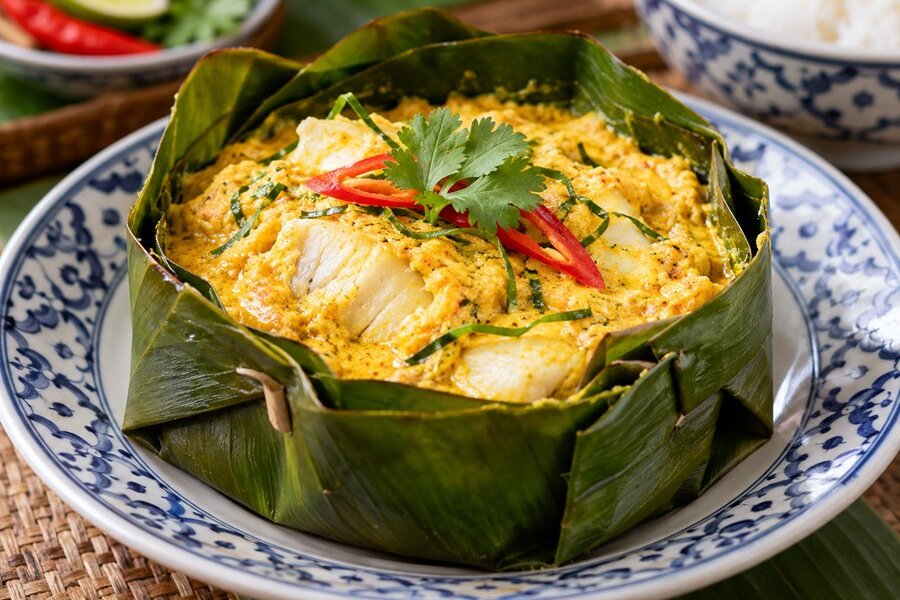
Amok (fish curry cooked in banana leaves)
Amok trey is steamed fish in a creamy curry with the consistency of a light mousse.
Pieces of freshwater fish, rubbed with yellow or green kroeung paste, are mixed with coconut milk or cream and an egg. The mixture is transferred to bowls rolled with banana leaves, lined with noni leaves, and steamed for 20–30 minutes, until it sets into a fluffy soufflé. The word "amok" itself refers to this steaming method. It is served hot, with rice, sometimes in a coconut shell.
Amok is considered a dish from the Khmer Empire, once prepared at the royal court. However, this version is passed down only through oral tradition, and its origins are disputed among neighbors – Thais have their hor mok, while Malaysians and Indonesians have otak-otak. Restaurants also serve amok with chicken or tofu. The real challenge, however, is the fish version: delicate, aromatic, and completely unlike the curries you're familiar with from other Asian cuisines.
Lok lak (fried beef with Kampot pepper)
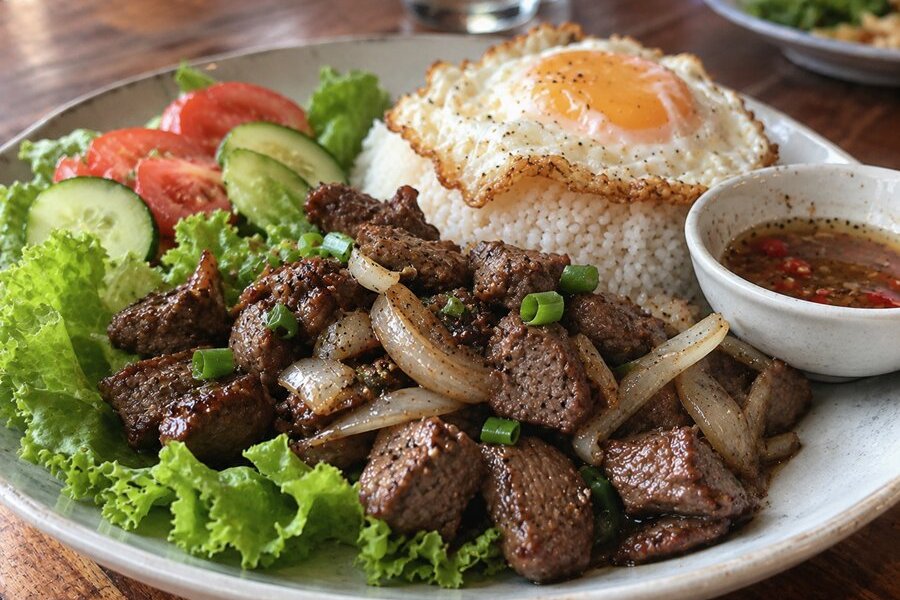
Lok lak are strips of beef fried in a wok, served with lime and pepper sauce.
The meat is marinated in oyster, soy, and fish sauce, then quickly fried over high heat. Instead of beef, you can order chicken, and vegetarians can order tofu. Everything is served on lettuce leaves, accompanied by tomato, cucumber, and red onion, usually alongside a bowl of rice and a fried egg. The real star, however, is the bowl of sauce: freshly ground Kampot pepper, salt, and lime juice. A piece of beef is wrapped in a lettuce leaf and dipped—carefully, as the sauce can be quite strong.
The name reveals its Vietnamese roots. Because luc lac, or "shaken beef," originated in street food joints. Saigon Made with French ingredients, its name alludes to the act of shaking a wok. The Cambodian version has evolved in its own way: originally prepared with high-quality steak fried in French butter, later with cheaper cuts and oyster sauce. Today, Cambodians consider lok lak one of their national dishes.
Kuy teav (traditional rice noodle soup with pork)
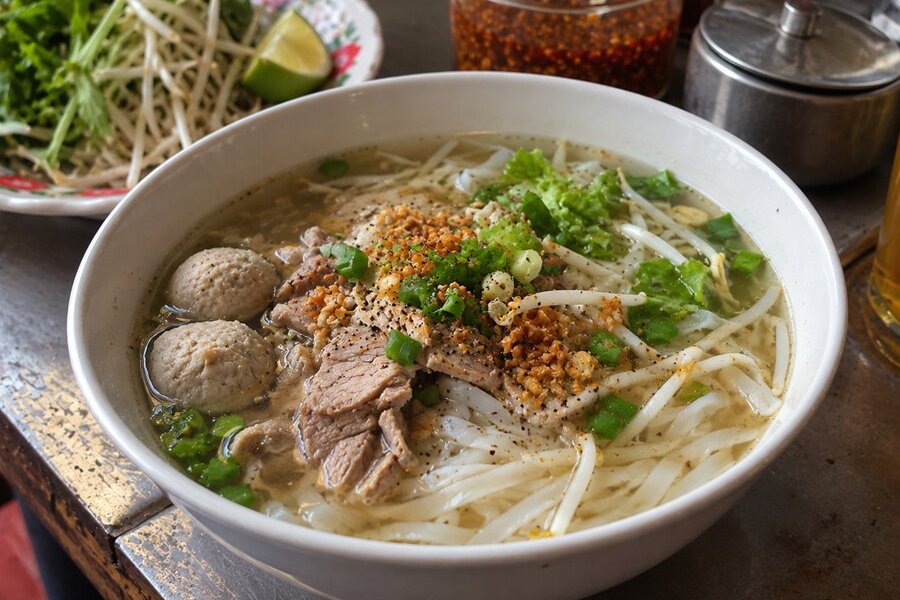
Kuy teav is a soup with thin rice noodles in a clear pork broth, the queen of Cambodian breakfasts.
Its name comes from a Chinese word from the Teochew dialect, meaning noodles cut from rice flour. The broth is simmered with pork bones, dried squid, a pinch of sugar, and seasoned with fish sauce. The noodles are briefly blanched, drizzled with oil and caramelized garlic, and then poured over with the broth.
The topping is whatever's on hand – a simpler version with ground pork and dried shrimp, a richer version with bacon, pork pate, offal, or seafood. The most sumptuous is the Phnom Penh-style kuy teav, with ribs, liver, and shrimp. The broth itself is mild, as the flavors are determined at the table: lime, Kampot pepper, bean sprouts, herbs, chili, and sauces. The soup can be ordered "wet" or "dry," with the broth separate, and is sometimes eaten with crispy deep-fried breadsticks. Don't delay – most stalls sell out by noon.
Nom banh chok (Khmer rice noodles with fish sauce)
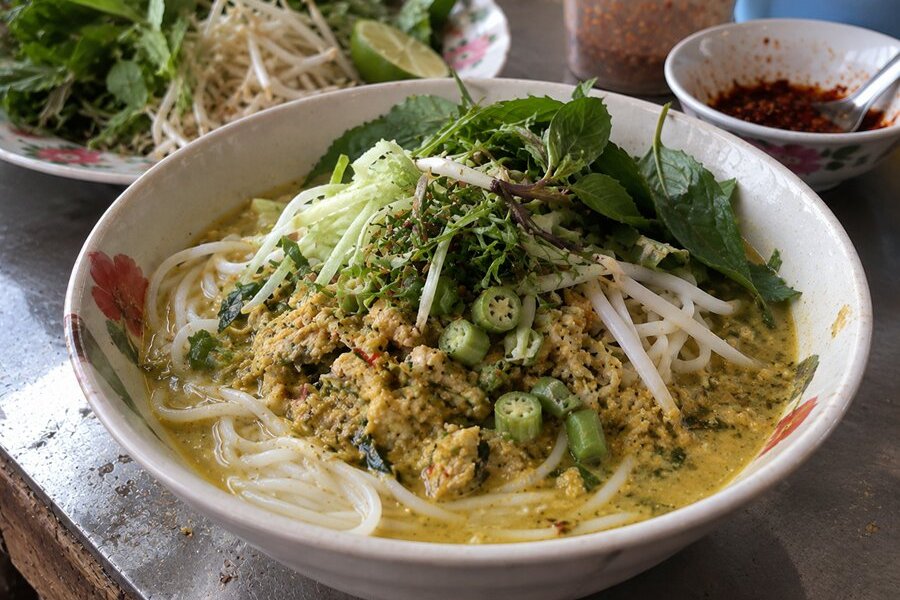
Nom banh chok is lightly fermented rice noodles served with greenish fish sauce.
Preparing the noodles requires patience: the rice is soaked for several hours, ground into a paste, drained, and then squeezed into thin strands directly into boiling water and then transferred to cold water. The most popular sauce, samlor proher, is cooked in kroeung paste with lemongrass, kaffir lime leaves, garlic, and turmeric, along with freshwater fish, prahok, and coconut milk.
Primarily a breakfast, it's eaten warm or at room temperature. Each region has its own version: in Siem Reap, the sauce is thinner and without coconut, while in Kampot, the noodles are eaten cold, with peanuts and dried shrimp. There's even a royal version with chicken liver, cognac, and green peas—a relic of the days when the court added cognac to traditional recipes. Folk legend has it that the scholar Thon Chey, exiled to China, sold these noodles so successfully that the emperor himself liked them.
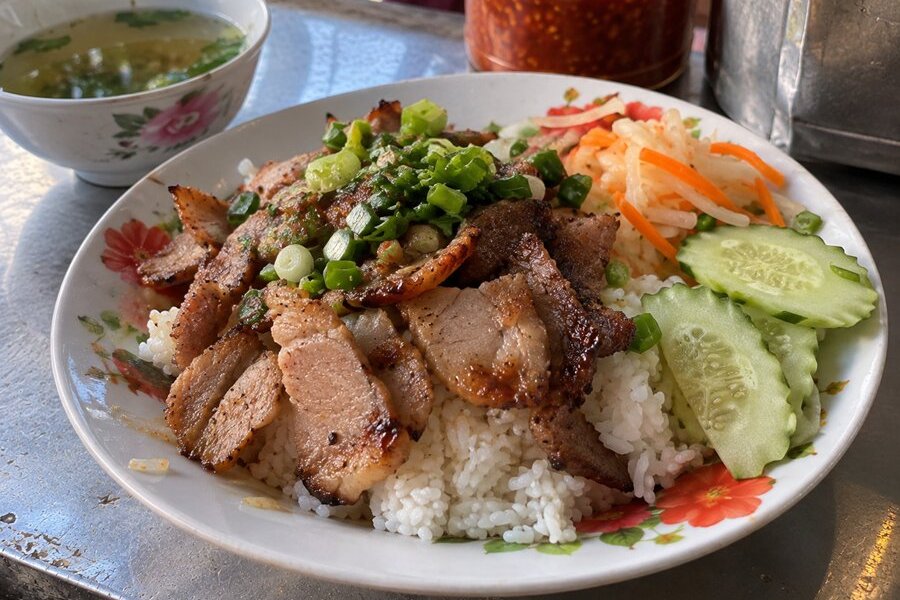
Bai sach chrouk (grilled pork with rice)
Bai sach chrouk is simply Khmer for “rice and pork” – and the simplest Cambodian breakfast.
Thin slices of meat are marinated in a mixture of palm sugar, garlic, coconut milk, and fish sauce, then slowly roasted on a grill over glowing charcoal. The marinade varies by region and stall, and the meat is typically grilled for a long time until it dries out slightly and develops a caramel flavor.
The pork is served on rice, alongside pickled carrots and radishes and a bowl of broth. Some people add a fried egg, and iced coffee is ordered to top it all off. Bai sach chrouk stalls open early in the morning and can be found in almost every city, with lines forming outside the most popular ones in Phnom Penh. If you want to eat breakfast like a Cambodian, just follow the smell of smoke – this dish surprises with how much flavor is packed into just three ingredients. It's not for nothing that it's called the Cambodian answer to American bacon and eggs.
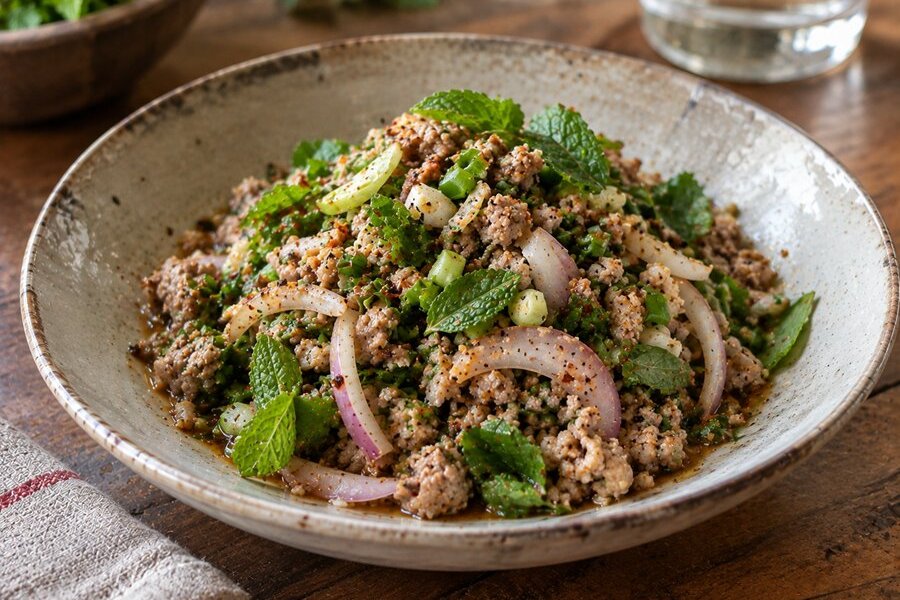
Lap Khmer (Spicy Beef Salad)
Lap Khmer is a salad made of thin slices of beef "cut" in lime juice, called Khmer ceviche.
The meat is steeped in lime juice, which changes its texture, and then mixed with lemongrass, shallots, garlic, fish sauce, basil, mint, green beans, and chili. Some recipes include toasted ground rice, which adds a nutty crunch to the salad. The dish is fresh, sour, and spicy all at once—perfect for a hot afternoon.
A fermented prahok sauce is used for seasoning, which can be replaced with regular fish sauce at home. Khmer lap is best served with white rice, and those who enjoy spice add fresh chili peppers. It's worth noting that many restaurants serving foreign guests serve the beef grilled version, while raw beef is more likely to be found at local markets. Lime is not a substitute for cooking, and raw beef carries the risk of poisoning and parasitic infections, so it's safer to choose the grilled version – the flavor of the herbs and lime remains the same.
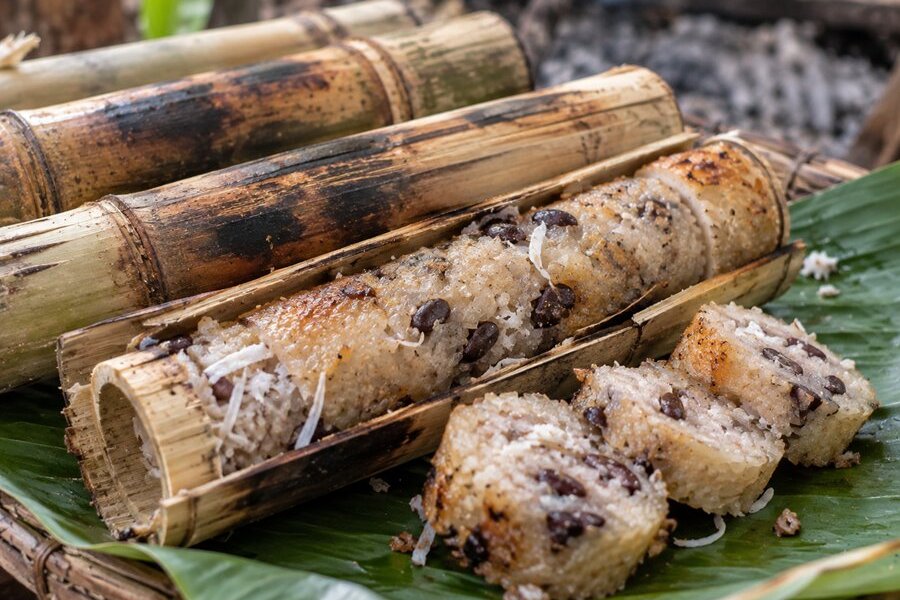
Kralan (sticky rice baked in bamboo)
Kralan is sweet glutinous rice with beans and coconut, baked in bamboo stalks.
Sticky rice is mixed with beans, coconut milk, coconut flakes, and palm sugar, placed in bamboo tubes, and roasted over a fire, usually for about an hour and a half, sometimes over two. The type of beans depends on the producer—black, red, or soybean. The bamboo imparts a delicate, slightly smoky aroma to the rice. Before eating, the outer layer of the bamboo is peeled off and the rice is pressed into a cylinder.
Kralan is primarily sold at stalls along main roads. The village of Samrong Khnong in Battambang Province is particularly famous for it, where travelers bring it to family and friends. It's also a taste of the holidays: larger quantities are prepared for the Khmer and Chinese New Years, as well as for the Pchum Ben festival of the dead, and some are given as offerings to the monks. Sweet, filling, and packaged in a natural packaging, kralan is the perfect snack for a long journey through the Cambodian countryside.
Bok lahong (Cambodian green papaya salad)
Bok lahong is a mashed green papaya salad, sour, sweet, salty and spicy at the same time.
Its name supposedly mimics the hollow sound of a pestle striking a mortar, as that's where it's made. First, garlic and chili peppers are pounded, then palm sugar, fish sauce, shrimp paste, and lime juice are added. Finally, strips of green papaya, tomatoes, green beans, and dried shrimp are pounded into the mortar—lightly bruised to crisp them up.
Bok lahong is always made to order and is most often eaten as an afternoon snack. There are versions with salted crab, fermented fish, and even vegetarian versions without dried shrimp. A final interesting fact: the main ingredient of this salad came to Cambodia with Portuguese traders, but today it's hard to imagine a Cambodian market without mounds of green papaya. Ask for less chili if you don't like spicy food, and eat it right away—the salad should be crispy, not mushy in the sauce.
Cambodian cuisine speaks more quietly than its neighbors, so it's worth leaning over your plate and listening carefully. Carefully crafted, based on fresh herbs and memories that have survived the most difficult years, it can seduce from the first bowl of kuya tea to the last slice of kralan. Before you sit down to the table, plan your route with a review. attractions and monuments in Cambodia, choose the time of departure with the text about weather in Cambodia, and about why this is an unobvious journey, you can read in a separate text. Ready-made routes can be found in Planet Escape programs. Have a nice trip!



November 13, 2026

November 10, 2026

November 9, 2026

November 6, 2026

November 5, 2026
November 4, 2026

recent posts
- Honeymoon trip to Morocco November 13, 2026
 International driving license – when is it needed? November 12, 2026
- The most beautiful lakes in Asia – where is it worth going? November 10, 2026